Monthly Archives: September 2011
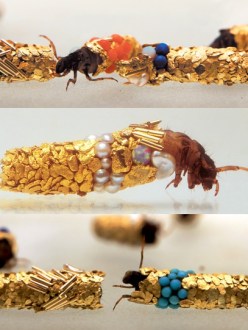
The bejeweled bugs of Hubert Duprat
Fascinating faces: Ulric Collette’s ‘Portraits génétiques’

Father & son: Laval, 56, and Vincent, 29 (2008-2009)

Mother & daughter: Julie, 61, and Amelie, 33 (2011)

Father & son: Denis, 53, and William, 28 (2008-2009)

Son and father: Nathan, 6, and Ulric, 32 (2011)
GUEST POST: Jessica Draper on Die Antwoord
19th Century Mug Shots from New Zealand
This slideshow displays a sample of the amazing 19th century mug shots that formed part of a show I curated at the New Zealand Police Museum last year, Suspicious Looking (available here as an online exhibition). Until then, these incredible images had never before been shown to the public. What is it about old mug shots that is so utterly compelling? When we look at them, do we try to see evidence of their criminal nature written in their expression? Can you guess what crimes they committed by looking at their faces alone?
To see more of these mug shots, along with their names and crimes, click here to go to the Picasa web album or visit the NZ Police Museum website here. For some ridiculously interesting facts about mug shots, read on… Continue reading
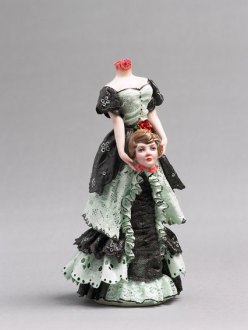
Corrupting the porcelain figurine tradition: Shary Boyle

Shary Boyle, “Snowball”, 2006. Porcelain, china paint. Collection of the Musee des beaux-arts, Montreal.

Shary Boyle. Untitled, 2005. Porcelain, china paint. National Gallery of Canada. (Image: artist website).

Shary Boyle, 2005. Porcelain, china paint. (Image)
Museum accession numbers are like gang tattoos

Left column: Museum objects with permanent accession numbers. Right column: Latin Kings gang tattoos.
I think one of the most bizarre museum practices is the act of marking museum artefacts with an accession number. Like the tattoos of gang members, it is a permanent symbol which marks their lifelong membership in a collective from which they can never again be completely separate.
The most common tattoo among gangsters of all nationalities is one that denotes the gang that they are in. This is seen as the mark of lifelong membership. The gang ethos of “blood in, blood out”–the idea that the prospective member must kill someone as the price of admission to the gang and cannot leave except by dying himself–is embodied in the tattoo as a sign of permanent belonging to the gang.
- Linda Goldberg, “Gang Tattoos: Signs of Belonging and the Transience of Signs” (2001)
Agnes Richter’s embroidered straitjacket

Straitjacket embroidered by asylum patient Agnes Richter in the 1890s. (Image: This Is Not Modern Art tumblr)
Agnes Richter was a German seamstress held as a patient in an insane asylum during the 1890s. During her time there, she densely embroidered her straitjacket with words, undecipherable phrases and drawings which documented her thoughts and feelings throughout her time there. This remarkable object was collected by Hans Prinzhorn, a psychiatrist who ardently collected the artwork of his patients at a Heidelberg psychiatric hospital in the early 20th century. Continue reading