
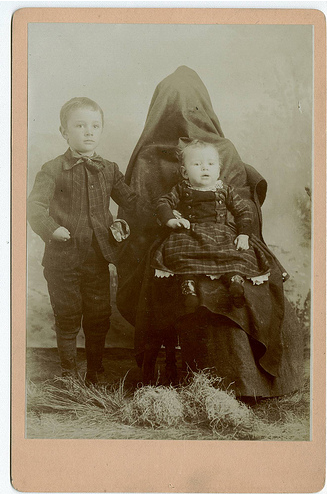


The first photographic images in the late 1820s had to be exposed for hours in order to capture them on film. Improvements in the technology led to this exposure time being drastically cut down to minutes, then seconds, throughout the 19th century. But in the meantime, the long exposures gave us a few unmistakable Victorian photography conventions, such as the stiff postures and unsmiling faces of people trying to remain perfectly still while their photograph was being taken.
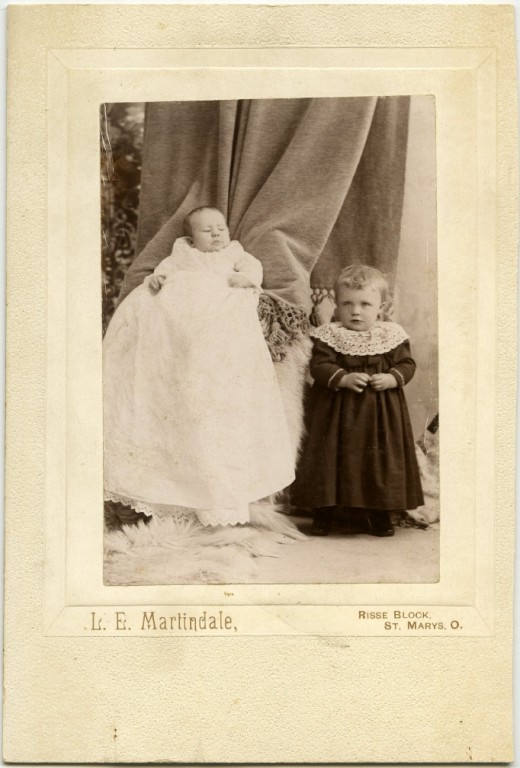
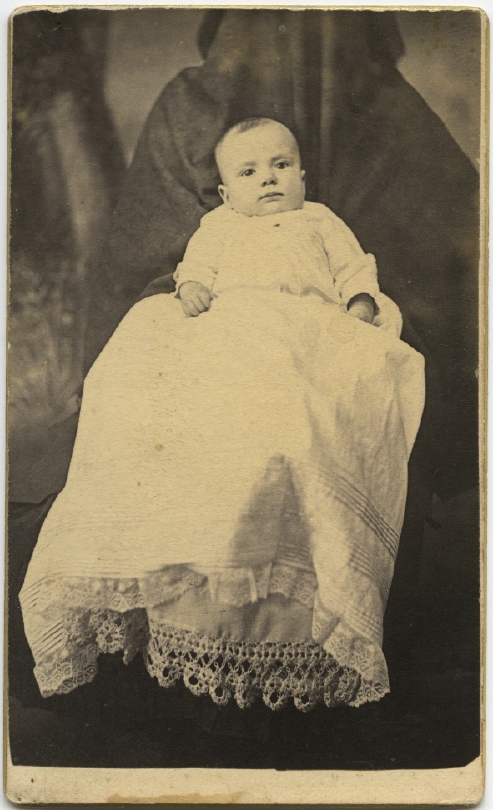
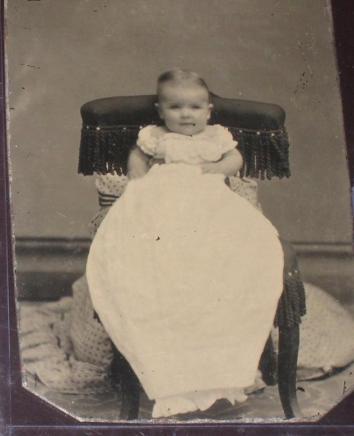
Seems children were just as squirmy then as they are today, because another amusing convention developed: photographs containing hidden mothers trying to keep their little ones still enough for a non-blurry picture. These fantastic portraits of children (found via Retronaut) all contain their mother, disguised as chairs or camouflaged under decorative throws behind them. Can you spot all the mothers (and one father)?
UPDATE 04/07/12: For more ‘Hidden Mother’ photographs, check out the follow up to this post here.

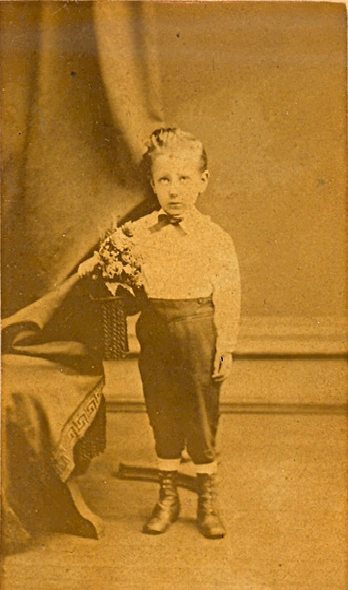
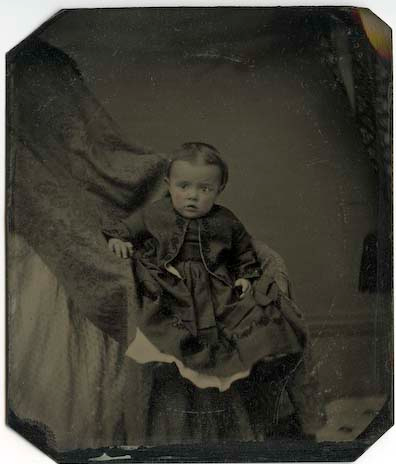
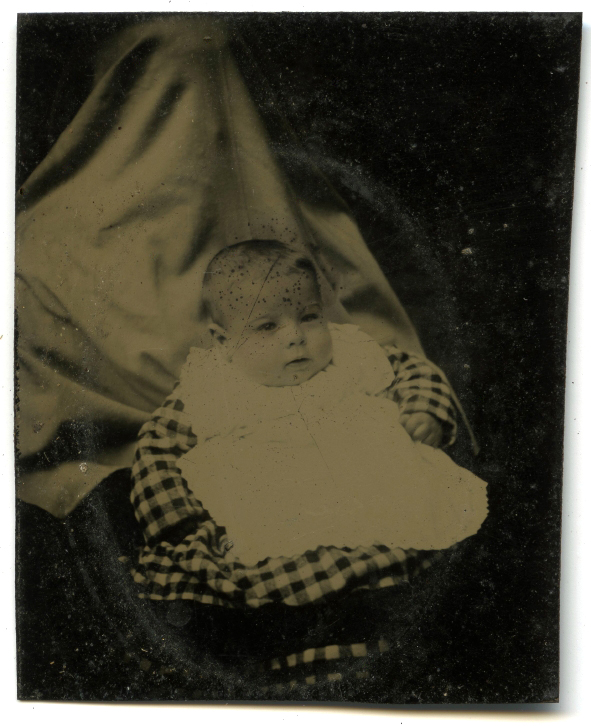
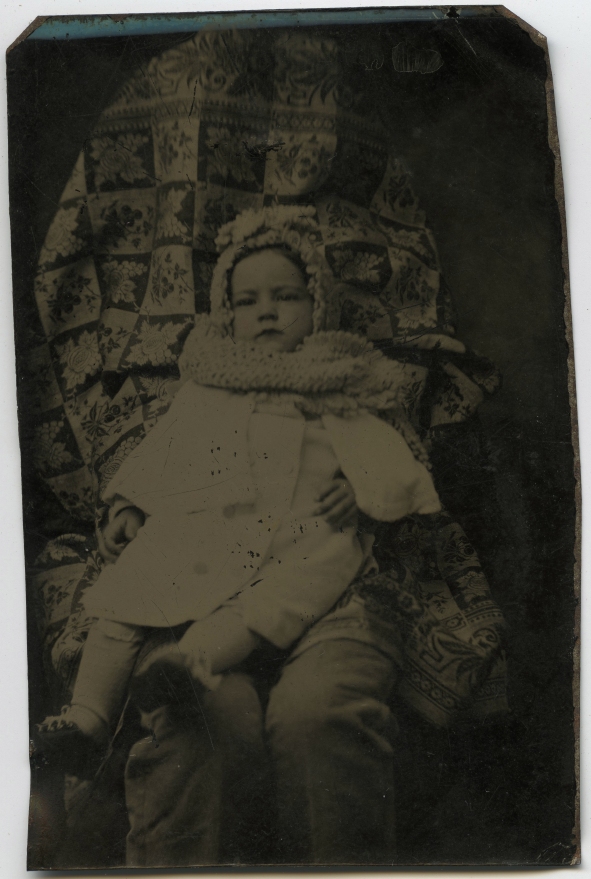
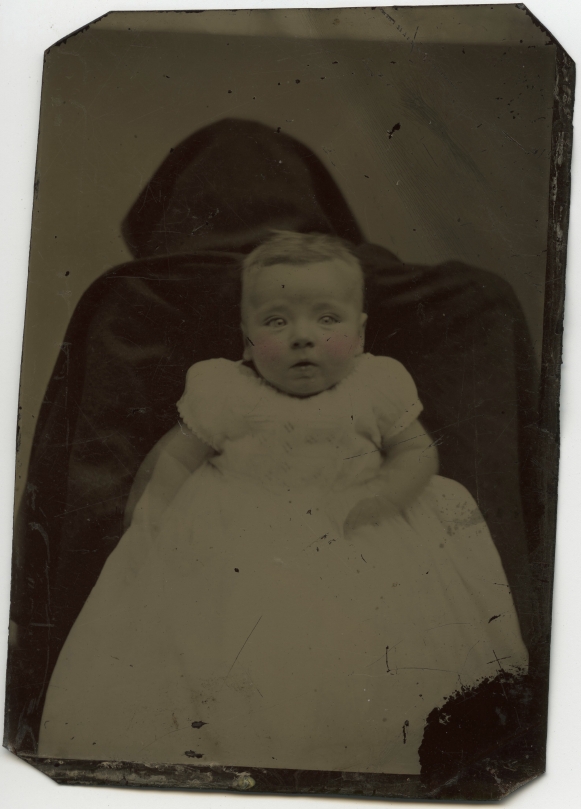
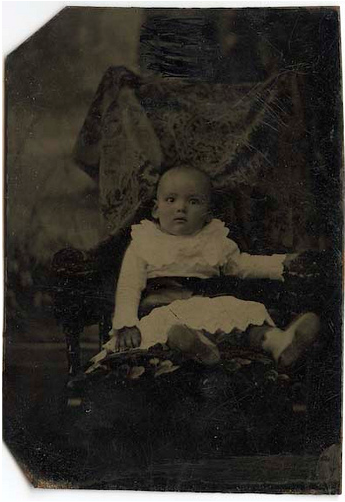
// Via Retronaut and The Hidden Mother flickr group. Thank you so much to my own lovely mother for sending me the link to these images! I promise next time we take a family photo we won’t make you hide under a blanket.
UPDATE 04/07/12: For more Hidden Mother images, check out the follow up to this post, “More hidden mothers in Victorian photography: post-mortem photographs or not?“
 The Museum of Ridiculously Interesting Things
Pingback: Images of Victorian Motherhood, Effaced and Exposed | Susan Elizabeth Cook, Ph.D.
Pingback: 10 Interesting Photography Facts – Photography
Pingback: Importance of Photography – ralffortuny
Pingback: ¡Que la madre haga de atrezzo! - Yorokobu
Pingback: Masters of Disguise? | Victorian Visual Culture
Pingback: Victorian Parents Hiding in Pictures to Keep Their Babies Still Long Enough for a Portrait | OMG It Went Viral
What an utterly peculiar tradition, that terrifies me! They sort of look like ghosts.
Pingback: wheres mum? | Intraterrestrials
Pingback: Photo Art Xanten Models | Wallpapers
Pingback: 30 Interesting Photography Facts
Whether the totality or whether some of the photos were taken post mortem will be debatable without the provenance of the photos.
I would, however, point out that the boy on the left in photo #2 has very dark hands. It is unlikely an effect of mere shadows, but likely the effect of blood pooling (http://en.wikipedia.org/wiki/Livor_mortis). That child had likely died earlier than the siblings. As a genealogist I am aware of about 10 siblings in my family who died IN ONE WEEK. Sometimes photographers were not available immediately upon death.
Victorians were also fastidious about cleanliness due to the knowledge of illnesses caused by germs (Pasteur 1860s). There is the possibility that some of these “hidden mothers” were, while attempting to get that “one last memory” of deceased children, also trying to protect themselves from catching that which had both killed their children and which might be passed to surviving children. This would have been especially important during epidemics of illness since it was long before antibiotics.
In the Victorian era the dead were prepared at home. Weddings and funerals were both conducted from home parlours, not usually from churches. Bodies were cleaned and prepped at home, and rural families made their own coffins and buried children on their own farms. Today we are far removed from death.
Photography of dead infants continues today but is socially unacceptable to talk about. However, ask any nurse in the obstetrics or pediatrics ward at your local hospital about photography practices of stillborn infants and deceased children. Dead children are one of the last taboos in modern culture. I know. No one wants to view the photo of my son.
In #8, you can see the body stand behind the boy….
Pingback: Just Like Daddy | sew in harmony
Pingback: Metti la mamma nel divano | Giorgio Sitta | Images and Words
Pingback: Unsichtbarkeiten | umstandslos.
Pingback: Photography – Pose! | ellynronchetti
Pingback: 看不見的媽媽 | dropBlog
Pingback: Bizarre Fakten zur Fotografie, die wirklich wahr sind | PhotoVenture
Pingback: Victorian Hensōjutsu | Broadsheet.ie
Pingback: Victorian parents hiding in pictures to keep their babies still long enough for a portrait [20 pics] | Funri
Pingback: Victorian parents hiding in pictures to keep their babies still long enough for a portrait [20 pics] | 22 Words
the children in pics are not deceased as seventh from top is Clive Palmers grand dad.
Pingback: Bizarre facts about photography we swear are true - PhotoVenture
Reblogged this on Memory Box and commented:
Gostavamos de restaurar algumas fotos como estas!
Love old pic’s always have, my granfoke’s had alot but when thay pasted thay was losted, well great pic’s would like to see more thank you xxx
Reblogged this on Patricia Rodrigues.
Pingback: “HIDDEN MOTHER” VICTORIAN PORTRAITS | HeardTell: Pack Library NC Room
Thanks a lot for sharing this with all people
you actually recognize what you are talking approximately!
Bookmarked. Please also discuss with my web site =). We may have a link
change arrangement among us
Pingback: Images of Victorian Motherhood, Effaced and Exposed | Susan E. Cook, Ph.D.
Images #3 and #8 above have stands behind them — does this mean they are deceased? Or was this a technique also used for live subjects, to help them keep their heads still?
Stands were primarily used on live subjects. Sometimes with a squirmy child a parent or even a photographers assistant would hold the child for reassurance. Invariably in these pictures there would be blurred fingers and toes, eyes were almost always drawn in. looking at some of these pictures I’m convinced several are post mortem most are alive one I think may have an older child in the picture with a baby sibling.
I found this hidden mother photo in my families photo album from the 1860’s(i think thats about the date): https://sphotos-b-dfw.xx.fbcdn.net/hphotos-prn2/1186026_10152221321138677_1584925655_n.jpg another hidden mother? https://sphotos-a-dfw.xx.fbcdn.net/hphotos-ash3/1208850_10152221318073677_1291999833_n.jpg
Pingback: Crouching Mother, Hidden Identity |
That is weird and funny
Pingback: Hidden Mothers | Wheeeeeeee
Pingback: behind the curtin | dmicali photography
Many of the children being held by hidden mom are dead. The Victorians really were creepy . In many of the photos several children are dead as there was a high child mortality rate at the time. That is why you can see they are usually held up by stands. As for the open eyes. They were either glass or painted on. Memento Mori was very popular back then. Mom was used to prop a dead child up and covered to look like a chair. Why the need to cover moms face was needed is beyond me.
no, they are not dead. They had to sit still for many minutes in order to get a clear picture, that’s why they look so static. Check out other pictures of the era, and everybody looks like a statue, immobile and unreal.
Photographing a mother with a deceased child not only imparts some of the mothers vitality on the child but also imparts some of the feeling of death on the mother. Adults photographed in their coffins, a task I’ve had to perform several times, never had a living person in the photographs.
What about the possibility that it is not a mother under the blanket, but a nursemaid or photographer’s assistant? Also, about STANDS….I have my own family picture from 1872’s of my great grandfather (Winthrop Travell) and his brothers. They are formally dressed, posed awkwardly, with stands behind them, (3yr.old brother tied to a chair), with stiff expressions on their faces. All the brothers lived to be old men.
Nope, not dead photos at all. The only reason they made the parents look like “props” is so the photo was just of the children. My Mom had photos of her grandparents/parents that looked just like this. If was a fad–it was only done when the kids couldn’t be trusted to stand still. You have to remember, getting a photo like this taken was VERY VERY expensive back then. You only got one take–and you didn’t want the kid to move and ruin the picture. That’s why the one kid is being held by the head–he wasn’t standing still enough. These aren’t dead photos and it’s just ridiculous to believe they are. There are plenty of real victorian and more recent photos of children that passed. The reason they were photographed once they died was pretty much what was already mentioned. Photos were expensive. A child might die and never have been photographed in their entire life. Or even someone older, there might not have been but a few photos of them their whole life. This was the only way they had to try to remember that person. Even when I was young, my Mom told me once that the photos she had taken every year before I started school cost her a week’s paycheck. Early 60s. And my Mom made decent money for a woman back then. So no, these aren’t dead photos. They are just regular photos and the parents didn’t want the kids to mess up and their hard earned money to be wasted.
My brother recommended I might like this website. He was once totally right.
This submit truly made my day. You cann’t believe simply how much time I had spent for this information! Thanks!
Pingback: Utah Doula | Weekly Roundup of Web Links | Andrea Lythgoe Doula Salt Lake City Utah
Mourning etiquette back then was very extreme how is a pm photo any more creepy then wearing jewelry made with the deceased s hair or the restrictions on clothes and social interactions?
What an amazing collection…..and the reason I stumbled upon your fantastic website, my sister-in-law having mentioned the ‘hidden mother’ phenomenon.
This is so very interesting! I have a degree in history, write Victorian and turn of the century fiction, and write a blog that focuses on the same time periods and have never, ever heard of this. Really great stuff. I’m definitely going to share this post with my readers. Thanks for posting it!
Sincerely,
Stephanie Carroll
Author of A White Room (July 2013)
The Unhinged Historian Blog
Love these images! The first photograph, by the way was taken in 1839. Most of these images couldn’t have been earlier than 1850s with the processes used. The first photographs used for portraiture had about 10-15 minutes of exposure. Still very long and uncomfortable, but not quite hours.
Pingback: Hidden mothers in Victorian portraits | eeamdworaczyk
Reblogged this on eeamdworaczyk.
Pingback: Not Quite Wordless Wednesday | Genie Roadtrip
I think “# 10” might be dead…because that peg on the floor behind him is an apparatus that was invented back then to prop people up in a standing position…you can see it on the floor behind his right leg
Great post, I´ve seen the pictures of the dead children, all of them so moving…
Pingback: Sunday Links - My Note Book
Pingback: Link dump 001 | johnblackspear
What makes you think these are mothers? These are probably, nurses, nannies, other domestic servants unworthy of being in a family portrait.
Pingback: Sunday Links « The Honest Courtesan
I’ve not read the comments properly – on my phone now and will read on a laptop – but the book Wisconsin Death Trip has a section on photos of dead children. It was the vogue around 1895 in America. The kids are quite clearly dead and some are in coffins.
There are some ugly kids in these photos but no obviously dead ones.
Pingback: Victorian Bizaar Infant Photography | Lexington Photography
Still amazed that they are still in focus, even if mother is there to hold them down! But they look a bit freaky! Some are not very well disguised at all!
Pingback: Freaky, but interesting. | Art 335 Chapman Inter Term 2013
It is still better than the Victorian photos of dead kids. Those are the creepiest.
This is so interesting. I love vintage photographs & have a teeny tiny collection. I’m not sure if any of them are deceased, but I recently came across a Pinterest board with all post mort. pictures & many of the clothing and poses were the same for non-deceased pictures, but I could definitely tell most of them were dead. Although I am sure there are pics out there of post mort. that I wouldn’t be able to tell the difference.
PS- this site is right up my ally- new follower here!
Pingback: The Hidden Mother - Ebeneeza K.
Pingback: On Mothers « On wishes and horses
Put a link to this in my blog. :)
Pingback: Post-Mortem Photography « Tabitha Runk
Pingback: Science & history: Muslim inventors, pro-choice establishment Christians, pre-tourism Japan, and more « Humanist+Humorist
Pingback: More hidden mothers in Victorian photography: post-mortem photographs or not? | The Museum of Ridiculously Interesting Things
Pingback: Science & technology: the cool, the useful, and the awesome « Humanist+Humorist
Amazing! Its in fact amazing paragraph, I have got much clear idea
concerning from this paragraph.
Is the third from the bottom a woman? They’re wearing pants. I’d assume it was the father or maybe a photographer’s assistant.
Pingback: Picture of Granddauaghters « Heritage & Hashtags
The child in the second picture is definitely deceased. You can see the stand behind him by his feet, and the mother is hold his head up. 100% deceased.
Nannies & maids would not necessarily need to be concealed — many American photos show caretakers holding or posing with their charges, see pictures taken before/during the American Civil War.
That’s in America. In England the servants were to be invisible. Governesses and nannies got no respect and it would have been inappropriate for them to be photographed with the children. They were only servants, after all.
Pingback: September 24 2012 – Hidden Mothers | No Dark Days
Pingback: Due to the long exposure times of Victorian photography, the mothers of children getting a portrait done would be camouflaged into the scenery. | SP.cm
Pingback: Due to the long exposure times of Victorian photography, the mothers of children getting a portrait done would be camouflaged into the scenery. | SillyPortal
Considering the social background of those children, I believe it is not the mother who is hidden here but most likely the nanny. These were upper class children – it would be undignified for their mothers to be reduced to furniture and camouflaged under throws and curtains. Instead, they’d pose next to their children wearing their best clothes and jewellery. However, what applied to the “mistress” obviously didn’t apply to the help. Nannies and wet nurses raised the children since birth and their presence was necessary to keep the youngest of them calm. However, they would “mar” the picture, if they appeared next to the children being photographed. That is why they had to be disguised as part of the decor (interesting implications here regarding the social status of servants in victorian times).
Pingback: Hidden mothers in Victorian photography « These Wooden Ideas
Pingback: Linuxette.org » De l'usage de la Burqa dans l'Occident Victorien
Reblogged this on Éjaculat de mépris.
I wondered if it has occurred to anyone that some of the hidden ‘mothers’ may not be the mothers at all. Photography was not open to the masses – too expensive – but I have noticed that a number of the portraits of mother and child/ren groups or just children that exist in my own family have been taken around the time of the father’s or mother’s death. In our portraits the children have not been younger than six years of age, so no need for a ‘hidden mother’. With babies and toddlers I fully understand that perhaps an aunt or grandmother would ‘pose’ with the child/ren for the photograph but be concealed. However, the clothing of the children in most of the pictures shown don’t have the appearance of ‘mourning’ as ours certainly do – black from head to toe including the girl’s hair ribbons.
I have also seen a stand used for both adults and children which had a semi-circular clamp which fitted around the back of the neck to hold the head in position the most essential part of the body to keep still.
Lastly, I feel that those who consider some of the above photographs to be of deceased children have obviously (albeit thankfully) never seen a corpse – no amount of make-up or artistic arrangement can hide the fact when you are looking at what is no longer a living, breathing person.
It’s a good point that they may not actually be mothers. Plenty of people have also argued that many of the hidden figures were probably not relatives at all, but photography studio assistants. Thanks for the comment.
I know I’m late to respond, but I have to say #2 has flowers, and this line was repeated in a few of the links: “Flowers were also a common prop in post-mortem photography of all types.”
All in all, very interesting article and comments!!! Thanks for helping move my Friday along to 5:00!
Pingback: Hidden mothers, post-mortem, and 1940s Italian-Americans | Glancing Backwards
Pingback: Friday Link Roundup | Jordan L. Hawk
Pingback: A day in the life: 3rd July 2012 | Frayed at the Edges
Pingback: More hidden mothers in Victorian photography: post-mortem photographs or not? | The Museum of Ridiculously Interesting Things
Pingback: Versteckte Mütter | verblonshen
Pingback: Ideas for Infant photos – from the 1890′s – photopayne.com
Pingback: Hidden mothers in Victorian portraits - London Moms
That is hilarious! Mom’s are still doing the same thing today…sending their kids out into the world and just sweating hoping that they’ll behave themselves. God forbid someone think I had anything to do with my child being anything other that naturally perfect, or sitting still.
I am late to this post/discussion (saw it on Reddit), but just wanted to say that my cousin gave birth to a stillborn child that she carried almost full term. They cleaned and dressed him, and the family each held him and took several photographs. At the time I thought it was a little strange/creepy, but obviously their decision and part of their grieving process.
This reminds me of that; perhaps it is simply human nature.
some of the children mentioned as possibly deceased, have bit blurry arms or and legs.
comes to mind also that during this time it was considered normal to give children heroin for coughs. these children might simply be drugged.
If you go to this link, http://margaretgunnng.blogspot.com/2012/01/i-see-dead-people-victorian-post-mortem.html it actually shows a drawing set up of the stands used… soooooo creepy!
Another angle to the subject of hidden parents on photographs: they have made a comeback because of passport regulations that require even newborn children to have photo passports.
Curious though: I have a dozen photos from 1930 to today with hidden adults holding kids in place. At least in my family, this is usual until today. Even my son have some pictures with someone behind a curtain or armchair when he was a baby.
I used to take infant portraits by putting a white baby blanket over my left shoulder the baby sitting in my left hand and I would support their torso with my right hand which also had the camera release. A Parent or sibling would stand close to the camera and as soon as the smile came the picture was taken. I did have a few innovations 19th century photographers didn’t have, film camera with leaf shutter and lets not forget the strobe lighting… I only needed the grin for 1/1000 sec. The way I posed the infants it looked as if they were sitting on their own.
Pingback: The Woman in Back | Macabre Hill
Pingback: Little Mary Sullivan « Pics of Then
Pingback: “Where’s Ma? Oh, she’s the one ensconced in the rug.” (Part II: Dead Babies?) « Susan E. Cook, Ph.D.
Pingback: “Where’s Ma? Oh, she’s the one ensconced in the rug.” (Part I) « Susan E. Cook, Ph.D.
Pingback: Elsewhere on the internet… « Mathew Lyons
Pingback: Hidden Mothers in Victorian Portraits « Archimedes' Archive
I don’t agree that these depict deceased children. I have little experience with momento mori photographs, but two thoughts:
I’ve posed for tintype photographs (as an adult art model) and I can tell you that children would a)ABSOLUTELY benefit from a stand or prop. It is difficult to hold the pose as a well-meaning adult; it would be neigh on impossible for a squirmy child. Your head and limbs quickly get tired and its hard to remain perfectly still for the 8-13 seconds the shot requires and b) Old-fashioned cameras of this type are quite strange in that when the lens is open there is a light behind it. So looking directly at the lens for the required length of time is incredibly difficult and the times I’ve tried it it is almost impossible not to blink. So looking away from the lens would have been necessary. Just some personal observations.
Thank you for sharing the personal experience. I assume these photos replicated the original methods and would clearly represent the procedures used in the 1800’s. I have had a difficult time convincing people of the exposure time. The usually refer to it in minutes, but that is inaccurate. It was much longer but by the time it became mainstream, it was down to seconds. Doesn’t sound too long, but still long enough to need some aid in holding still. In some of the above photos you can see the blurr caused by the child movement. A “dead” give away the child is alive and well. Sorry, couldn’t resist the punning. ; )
Please educate yourselves on photographic history before throwing dates around. There was no film as photographic base till the 1870s (setting aside isolated experiments). The earliest successful surviving permanent photograph we have is from 1826 on a PEWTER (METAL) plate by Nicéphore Niepce. The first viable photographic process which was essentially a direct positive image on a SILVER COPPERED PLATE, was announced by Louis Daguerre in 1839 in Paris. The first negative-positive process (on PAPER NEGATIVES) was introduced to the public by J. Fox Talbot round about the same time. And so on. At the very least anyone with basic general knowledge would consider 1839 (Daguerreotype) to be an important starting point for photography as we know it today (but vastly different from how we know it today). Just because it’s the 19th century doesn’t mean any decade and year would do. Where the hell did you get “late 1820s” from?!
I will concede that using the word ‘film’ in the first sentence was an oversight in editing, but as you said yourself, it was in 1826 when Niepce managed to create the first permanent photographic image…that’s where the hell I got the late 1820s from. This was not a post detailing the early experiments with photographic processes or making any claims to the most important starting points of photography as we know it today, but about a funny photographic convention that developed many years later. This is the imperfect art of writing for a broad audience and not a refereed journal, Curmudgeon Academicus: in order to give a brief context for why something developed, you might have to reduce complex concepts and epochs of history into a single sentence or word (think, for example, when people refer to the ‘Ancient World’). I appreciate your obvious passion for the history of photography and your eye for detail, but your point would be better served with a less condescending attitude. No one respects Comic Book Guy.
That date indeed is a pivotal point in the history of photography, Chelsea! It may have taken eight hours of exposure time, but it proved it could be done. Your reference to “film” didn’t bother me in the least and I’m well aware of it’s history. This is not the place to nit pick about semantics. And you’re right, had it been a vital error on the subject, politeness and tact gains more students than rudeness and arrogance.
Well, such shadows follow us for a long time afterwards!
Pingback: Victorian Ghost Mothers – On Shadow
I agree, that is ridiculously interesting (and odd)
O.M.G. This has to be one of the weirdest things I’ve seen (yes I live a quiet life). First the pictures were strange enough, with the cloaked mother/guardian but then to think they may be deceased is just plain bizarre. It’s giving me that weird feeling where I don’t like it but I keep going back to look. :o
Haha I know the feeling! I think th at the sensation of wanting to look away but then going back to it is often the essence of what makes something ridiculously interesting for me…
that is hilarious and very very very odd indeed!! Just popping by from pinterest!
These are creepy cool! I love this post Chelsea. :)
I read on another site that the photos were displayed and thus the hidden adult would be cropped out. So, hung on the wall in a frame with a mat, maybe they did not look so creepy.
Yes, I think that is a very good point to mention! I think the intention for many of these photographs was to go into family albums, so they would likewise be cropped and matted to help hide the hidden mother. Thanks for the great comment.
Look at photos 9 & 10. You can see the circular imprint left by the pen beck frame used to house these early tintypes. You can clearly imagine how it would mask the “hidden mother”. I love these and have several myself, as well as many post mortems.
Hi. Chris (Static Instincts) follows my vintage photo blog and invited me to check out this post and thread of comments. I’d like to add a few thoughts, if it’s understood that I am NOT an expert, just a hobbyist.
First of all, Chelsea, it’s wonderful! I love these photos. Not long ago the concept of the hidden adult in child portraits was completely new and weird to me. Thanks for posting some fine examples. I suppose that, as weird as it looks to us today, it must have been an accepted convention at the time.
While most post mortem photos look like pictures of corpses (which they are), there are memento mori photos that are remarkably lifelike. Typically they are posed in bed or a coffin, but sometimes they are sitting up, posed with other relatives, etc. Sometimes their eyes are open, their cheeks tinted, etc., in an effort to show them as they were in life. So while I don’t want to wager on specific images here, there is the possibility that one or two of these might be post mortem.
It was indeed common for fidgety children to have to be restrained for the long exposure times that were required by the photographic technology of the day. Poses would have to be held for up to a minute or so, depending on the available lighting. So measures such as the hidden people shown above would be taken. Head clamps and other bracing devices were also used. I’ve even read that children were sometimes simply tied to a chair. (Photos of animals presented similar problems.) And Chris, I’m sorry to contradict, but such measures were commonly taken with adults, too. Holding even a simple pose and facial expression perfectly still for that long can be harder than it sounds. Incidentally, if you look at the floor behind the child in Photo #2, you’ll see the feet of a head clamp stand (though it appears he is getting some human help from behind the drape as well).
Here are a couple of examples from my collection that I can contribute to this discussion. The first is a covered adult holding a baby. (I recently found another one in my boxes that I’ll have to post soon.) The handwritten notes on the back indicate he died at age 17, so he wouldn’t have been dead in this picture. My comments reflect the fact that the convention was new to me at the time I posted it:
http://picsofthen.com/2011/07/30/funny-cdv-of-infant-with-shrouded-adult
And here is an example of post mortem photos:
http://picsofthen.com/2011/11/02/dia-de-los-muertos
Thank you for the wonderful insights, usermattw.
Besides why would children above the age of 5 really need someone holding them still? I understand infants and newborns. I agree that you are right about the mori normally being shot as sleeping or in bed surrounding by flowers and the such though (i should’ve said that earlier).
I was teaching a group of first year undergraduates a few weeks ago and thought about your comment. Children above the age of 5 really shouldn’t need someone holding them…but yet, here I was, wishing that I had something of those handy Victorian restraint device to keep these 18 year olds still.
http://en.wikipedia.org/wiki/Post-mortem_photography
Think about it. There has to be something/someone holding the corpse in post mortem victorian era shots. Why would they use a stand behind subjects other than to prop them in place? If it was indeed part of the back drop then it would’ve been in frame and available to plain sight. Wrong or right I can guarantee that shots 2 and 3 are post mortem in fact. If you closely at the child with his “eyes” looking upward. To me this indicates a influence of religion and the passing of the soul. We’ll never know I guess!
On the question of using stands, I have numerous examples of adults with those stands. The person wasn’t just sitting down, having a photo made, then standing up again to leave. Think about any time you went in for a photo sitting (graduation or wedding?). The photographer has you turn at different angles, adjusts lights etc. Well, Victorian photographers considered themselves artists, so they put together a beautiful vignette which included a person. So the person sat down, was adjusted this way and that, props were added or subtracted, the camera was consulted, further adjustments were made, etc. until the photo was taken. It was surely far longer than 10-15 seconds. I’d guess more like 1-2 minutes for the set up at least.
Very good point, however by the time of the cdv and cabinet cards the exposure time necessary wasn’t that long at all, but as you mention the set up and adjustments were more difficult and time consuming. That is why the posing stands we’re necessary. They were much to flemsy to support the dead weight of a corpse.
None of these children are dead. The parent, typically the mother, would hide under a covering to hold the child in place during the exposure. If you research actual Memento Mori photo’s you’ll mostly see the dead person/child usually either in a casket or posed as if sleeping, and on occasion they’ll pose a person sitting. In typical Momento Mori poses you won’t see the same shrouded guardian as the subject isn’t moving anyway during the long exposure times.
Here is a good example of Momento Mori:
http://cogitz.com/2009/08/28/memento-mori-victorian-death-photos/
Actually the first photo introducing the photo gallery is considered by many to be a rare “pre-mortem”. Death was emminant and the family was lucky enough to get a photographer there before the actual passing of the person. These are truly deathbed photos. The most touching in my opinion.
This is so cool Chelsea! I love the extra info from Static Instants as well. Painting pupils on the closed eyelids of the deceased? Very macabre!
Thanks for the interesting read.
Thanks Heather!
Honestly if you think about it why would the mother or father cover themselves? why not just have the picture taken with them shown? I guess they wanted to have one last shot of their children alone, unbridled and proud in nature. I’m going to stop now I’m starting to ramble lol.
Ok; pictures 2 and 3 are 100% photographs of deceased children. Look closely behind them and you can see a prop stand. Then shots 1,4,6,8,9,11,12,and 13 look like deceased children. The pink hue is from the outside application, it helps make the child look alive. When they first utilized this style of production they were able to apply simple colors to the end result. Other words early color photography!
That is so cool, and completely creepy. Thanks for the great info and the sharp eye!
Your welcome!
I disagree about photo 3. The positioning stands were used especially in early photography because of the long exposure time. I think photo 3 is just a photo of a little girl. People were also directed to look away from the camera because it was less likely their eyes would blur. Actually I disagree about most of these photos being memento mori. #2 looks strange because the child appears to be looking up and due to the long exposures it would have been difficult and tiring to hold the gaze looking up for that long. That would I would buy as being a memento mori, but none of the others.
If you look at the second picture on the first page you can see a stand right behind the little boy. They would actually strap or suspend the children or person to show them in a life like form. Sometimes if you look at the limbs and notice just how stiff they look or if the eyes are focused on a crazy angle away from the center of the shot are indications of a deceased subject. Sometimes, also, they would paint the pupils on the eyelids of the person if they’re eyes were shut! Craziness!
The posing stand was used in the early photo sessions to hold particular positions. Standing post-mortems are very, very rare. Much of the posturing and demeanor of the subjects are actually a throw back from the early days of painted portraits. A posing stand is not an indication of a pm. I have researched looking for documentation od such a practice and have yet to find any. The tinting and eye painting were early versions of photo shopping and “touch-ups”. The question of pm or not is a very touchy subject with many collectors. Personally, I see no pm’s in this group. If any, maybe a slim chance the last might be.
Time Machine is correct. I have been studying/collecting pm’s for over a decade and I can tell you with certainty that there isn’t a single one in this bunch. The posing stand was to keep LIVE people still during long exposure times, not dead ones (As is commonly believed).
Since there are a few people here who seem to know PM photography well, can anyone tell me with any certainty if this photograph is post mortem? I found it in a funny little antiquey sort of shop, and I felt I needed to buy it.
http://theprocrastinatingfilmstudent.wordpress.com/2012/10/03/morbid-delights-my-first-post-mortem-photograph/
But weren’t live children sometimes restrained in place to keep them still so they didn’t blur up the picture?
I agree that Victorian era photography was interesting aka bizarre. The covered parents in these pictures are just disturbing. Which picture do you think has a deceased child? They all look alive to me, but I’m often wrong.
Actually it looks like four of them are deceased imo. Memento mori is a very interesting aspect of the wealthy Victorian lifestyle.
Is that why they’ve tinted the cheeks in some of the pictures of the babies? To make them appear alive? Very very interesting.
Many many photos were tinted, it was considered an art form. I have many photos of very alive babies with tinted cheeks. :-) I also have several hidden mother photos, some are really creepy huh?
Hipster Victorians…tinting photos before Instagram.
They did add tinting to some. I posted a link above with a bunch more dead person pics. (hooray?)
A lot of the hidden parent scheme was used as a last farewell also. The majority of the Victorian photos that I’ve seen that implement this are ones that depict deceased children. I am almost certain that the last picture shows a deceased subject. i’m sure that you already knew all of this info based on your profile information but I had to type it because it makes me feel important! Hah! BTW the Victorian era of photography was extremely…. well…..interesting to say the least.
I didn’t know that! These hidden mother pictures were already kind of unsettling, but that just takes them to a whole new level. Thanks for the terrific comment!
Yeah, just found this gem of post-mortem Victorian photos after reading the above comment:
http://margaretgunnng.blogspot.com/2012/01/i-see-dead-people-victorian-post-mortem.html
Chills to the bone. So glad that tradition faded.
But why would they need a person to keep them still if this were the case? They could just prop them up on a chair or something. Not that I don’t believe you. It’s just strange.
The last one actually looks like the kid is strapped to something, not on someone’s lap. but if you click the link I posted above, you’ll see more examples of the same creepy thing.
I believe that the mom was used to keep the child in position, ( from falling over), I’m guessing some parents wanted a lifelike, not sleeping type of picture of their child. I think depending on the type of chair used it would be hard to prop up the child, just my guess,,
the ex poser time for taking a photo then was much longer
these photos the children are alive it took longer with about a 10 20 sec ex poser so someone was covered up to keep them still,yet they did use stands for taking photos of dead people to be taken next to living family
I don’t see any evidence the kids in these photographs are deceased. They DID take pictures of the deceased in this era, but their eyes were always shut, and their mothers weren’t there to hold them still, obviously.
Maybe have a follow-up gallery of “deceased people” photographs and you can see the difference between the two.
See link above. And false that their eyes were always closed.
Yeah their eyes were not always shut, in fact it was quite common to have them open or to paint on the eyelids to make it look as though their eyes were open. You can actually see the stand that held up their bodies behind the children’s feet in these two pictures: https://ridiculouslyinteresting.files.wordpress.com/2012/01/hidden-mothers-5.jpg

I don’t think that the last one is of a deceased child, you can see a bit of blurring about the feet, which in my mind shows that the child moved. (or perhaps was moved)
When photographing deceased children , their eye’s were closed to make them look like they were sleeping. That, coupled with the motion blur on a few of them, makes me think that these are all living children.
Not true that their eyes were always closed. See my link above.
But why would you need a hidden mother to hold still a deceased child? Surely they could simply be propped up in the wanted pose and left motionless for as long as the shutter had to be open?
See Curses in Cursive link
Wow, this is awesomely creepy.