
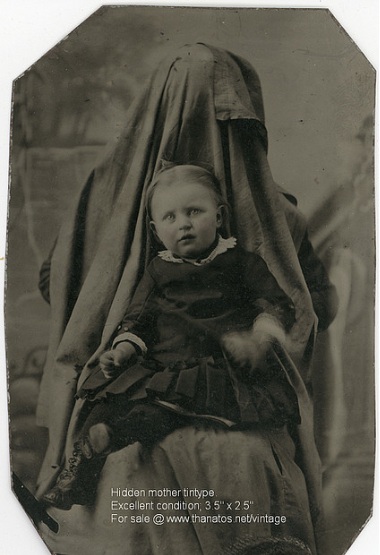
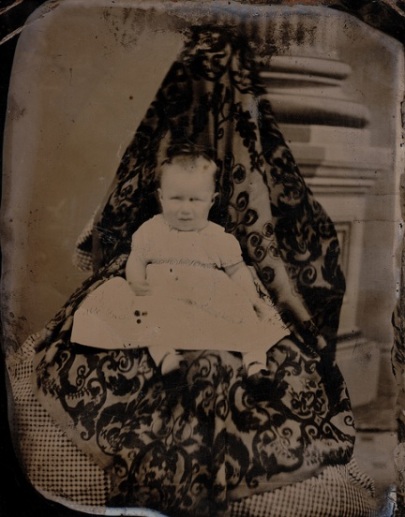
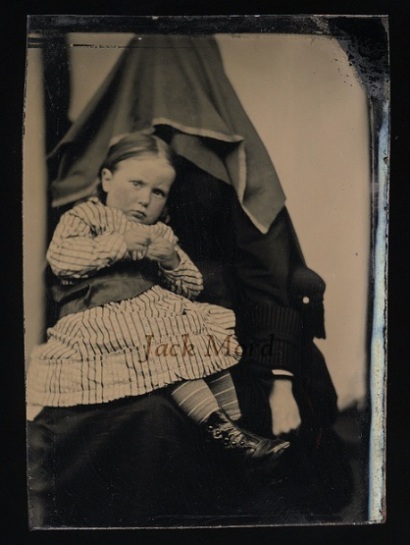
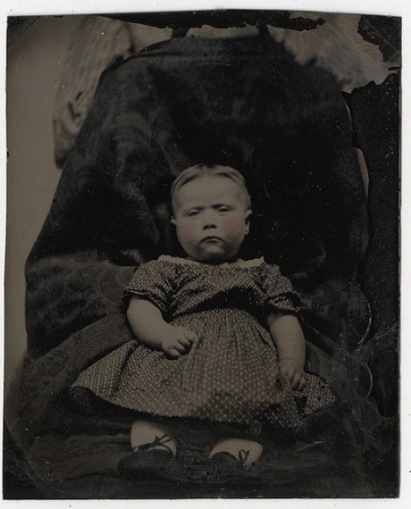

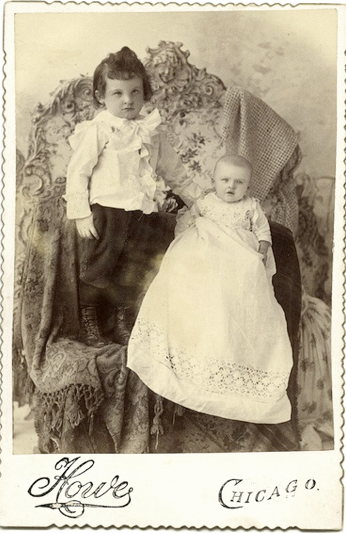
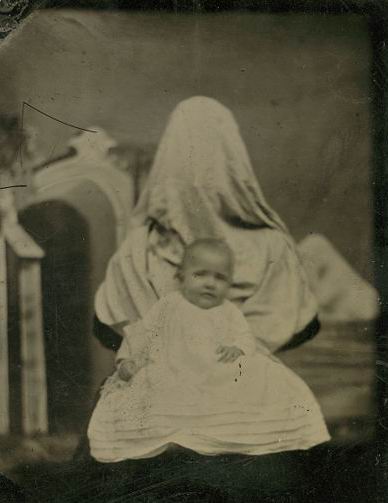
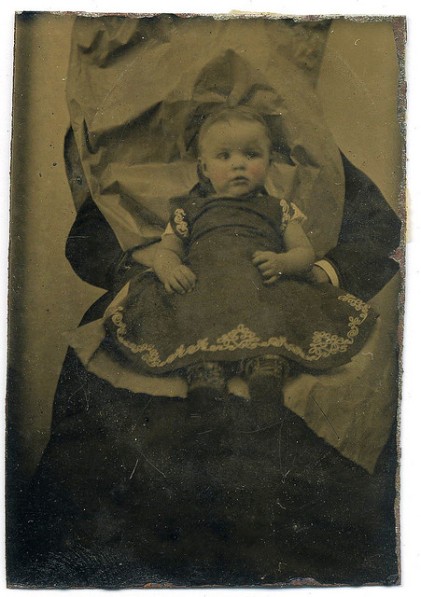
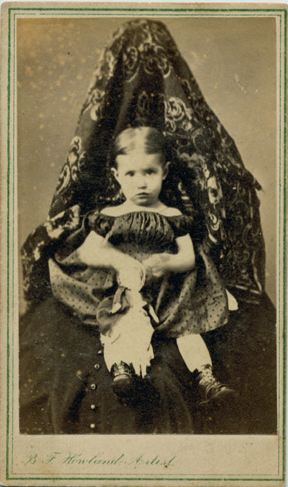

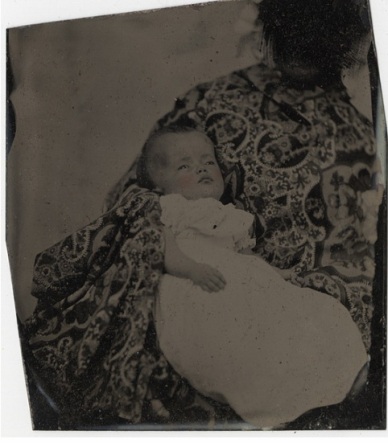
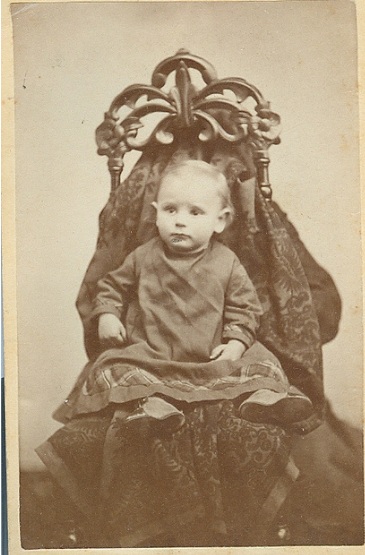
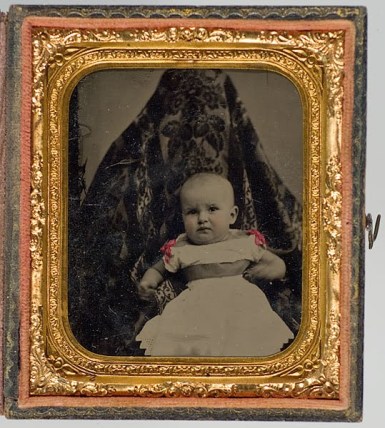
As I mentioned in the original post on Hidden mothers in Victorian portraits, in 19th century photographs of children you can sometimes spot a mother hiding behind a chair or underneath a decorative throw, ostensibly trying to hold their squirmy children still during the long exposure times of the camera. (You can see the original post and images here.) The response to the first post on ‘hidden mothers’ has been almost as ridiculously interesting as the phenomena itself, so I thought it called for a follow up post in order to show some more of these intriguing images and to share some of the insights and debates that these photographs have stirred.
In short, are any of the children in these images dead? And if so, why is the mother hidden?
After the original post was published, an interesting debate took place in the comments section about whether or not any of the hidden mother images were post-mortem photographs, a suggestion originally put forth by photography blogger Chris from Static Instants. He pointed to the stands you could see helping to prop up some of the children, which might have been used to position the body and help give the deceased a life-like appearance.
Several other commentators disagreed (including the fantastic vintage photography bloggers Mrs Marvel from Who Were They? and usermattw from Pics of Then), and were quick to point out that these propping stands were primarily used to keep live subjects in position, and that deceased subjects were usually positioned in coffins or like they were sleeping. (To illustrate this, one comment provided a great link to a gallery of compelling memento mori post-mortem photographs on Cogitz.)
Others who disagreed with Chris pointed out that you could see subtle blurring of the feet in some of the photographs, where the child must have moved while it was being taken; others argued that there would be no need for a hidden mother to hold a dead child still during the photograph.
 I’ve gone back and forth whether or not any of the children were deceased in the photos, but was pretty convinced that they were all alive….
…until yesterday, when a new reader sent me this link to an AMAZING blog post on Victorian post-mortem photography on Margaret Gunning’s House of Dreams. Margaret argues that the post-mortem photographs which show people in coffins was a later development, and that earlier images usually try to make the subject look as lifelike as possible.
She includes some chilling examples of post-mortem photography which makes the theory that some of the ‘hidden mother’ children are dead seem a lot more plausible (like this photo, or this one). But most importantly, included in her gallery of post-mortem photographs was this incredible image of a deceased infant WITH A HIDDEN MOTHER IN THE BACKGROUND! (the image to the right)
So we know at least one post-mortem photograph with a hidden mother exists, and I think a compelling case can be made for at least a few others, although I suspect the majority depict live children. What do you think? Are you convinced some of these pictures might be post-mortem photographs or do you see unmistakable signs of life?
Either way, I bet you’ll never look at a 19th century photograph of a child again without searching for signs of a hidden mother or without wondering if they were alive or not when the picture was taken.
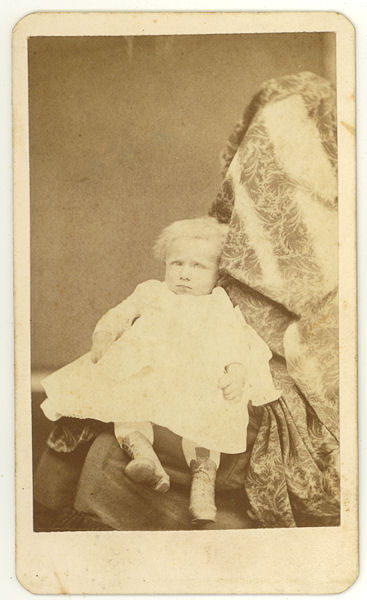
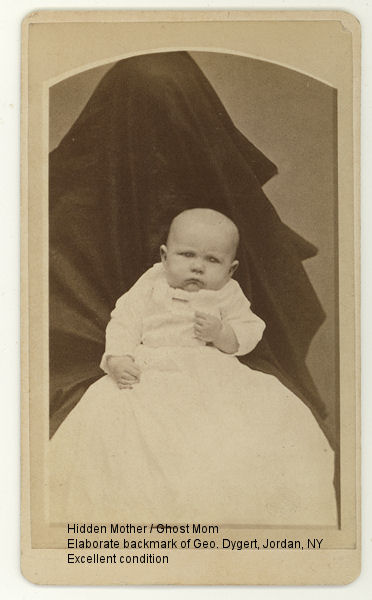
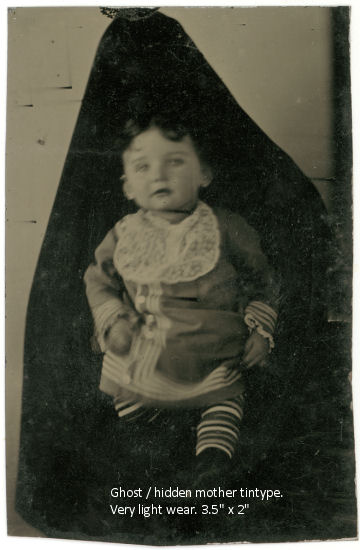
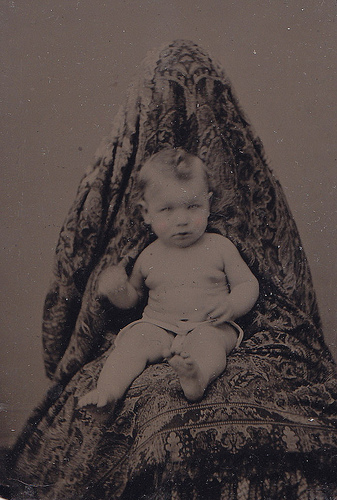
// Photographs in this post are from a range of different places: click on individual images to go to the source.
Susan E. Cook has also recently posted some thoughtful insights into the ‘post-mortem or not’ debate regarding the ‘hidden mother’ photos, and you can read her comments here and here.
 The Museum of Ridiculously Interesting Things


Pingback: Images of Victorian Motherhood, Effaced and Exposed | Susan Elizabeth Cook, Ph.D.
Pingback: Máscaras de lo invisible | TURMA plataforma de educación, producción y difusión de la cultura visual latinoamericana
Pingback: Down the Rabbit Hole
I believe I have one that the baby is post mortem. I will share if you’d like:)
All these children are not dead, when looking for a Victorian death photo you must look at the natural way a person would hold their arms or hands. A face with an emotion shown is not dead. But the person with an unnatural arrangement of head or hands, arms is more than likely dead. Also if there is blurring of the hands, that baby is alive. Interesting pictures, and a look into Victorian times.
Someone may have already mentioned this (I have not followed all of this extremely lengthy discussion), but was it not a practice in Mexico in the past to photograph deceased infants?
I’ve seen several of these photos elsewhere and some you can clearly see depict dead children. The children were “sleeping” in the photos and most looked skeleton thin…eyes sunk back into their sockets etc. As for the clothes of mourning.. Well maybe not everyone would be in all black. The reason I say this is because several years ago my grandmother died. When we cleaned out her house we found a trunk full of old photos. Several showed children sitting in chair or beds sleeping with their toys around them..one photo showed numerous adults all in somber clothing. One woman appeared to be in black with a black veil holding a little boy whose eyes were open but sunk back in his head. The rest of the others were in darker clothing which may or may not have been black.
Also there were pieces of jewellery that were made out of human hair and were actually really pretty. Was the hair taken from the dead person and made into a keepsake?
My great grandmother made a watch fob for her husband out of her own hair, while they were both young and no one had died. I don’t know how often jewelry was made from a dead person, but I woundn’t be surprised.
I’ve seen sever of these photos elsewhere and some you can cleay depict dead children. The children were “sleeping” in the photos and most looked skeleton thin…eyes sunk back into their sockets etc. As for the clothes of mourning.. Well maybe not everyone would be in all black. The reason I say this is because several years ago my grandmother died. When we cleaned out her house we found a trunk full of old photos. Several showed children sitting in chair or beds sleeping with their toys around them..one photo showed numerous adults all in somber clothing. One woman appeared to be in black with a black veil holding a little boy whose eyes were open but sunk back in his head. The rest of the others were in darker clothing which may or may not have been black.
Thank you for a very interesting article/post about this subject, to be honest even I was fascinated with this type of photography and I can’t imagine the pain a mother could been endured while posing with their deceased child/children. I read on some articles that those were days when photography is on scare so most of the family only takes photo of their deceased in their last time/hour before they will be buried so they take a final photo with them as a memoir. Thank you for sharing, i will read more of your articles next time.
The whole subject of memento mori, especially as related to children, is incredibly complicated. There are not only genuine photos (although many I’m convinced show live children) but other common forms were castings, carvings of limbs, even the somewhat gruesome-looking “mummified children” – if indeed ANY of those are real!
Death, especially of children, was an everyday, home event of Victorian life; even the richest families usually buried several children. It wasn’t the sterile, distant procedure we have made it today…
In terms of reality, there are a couple of things that interest me. There wasn’t the sophisticated embalming and recreation processing of today, nor the freezing. In order to pose a body at all, it has to have passed out of full rigor and, especially in hotter weather, unmistakable signs would show. And, apart from tiny infants, death usually followed a period of sickness, yet the supposed deceased rarely shows this.
The real kicker for me though is the clothing of the other family members. Early photography was largely a province of the middle and upper-classes and, in common with everything else, mourning followed strict timelines and rules. So, if other family members are shown dressed normally, surely this would be a dead giveaway that they’re not…well, dead! The mother of a dead child would certainly be in absolute mourning, and those I think could possibly be genuine do show classic mourning clothes and postures.
I’m no expert on photography or Victoriana; these are merely the disjointed musings of an interested idiot. Be interested to know what others think…
I couldn’t leave memento mori subject alone, the past few days…even though it unsettled me, and had me lying scared in my bed thinking of some of the images which, sad though they were, were also a little absurdly frightening. Can you see, for instance..the look of fear and dispair on the faces of some of the siblings, made to pose alongside their brother or sister as though everything is ok?
You are projecting today’s views on the Victorians and it is simply not true. They didn’t look at death the way we do and it was all too common. That deceased person was a sibling, a best friend, a playmate so why be afraid? My gram was 10yo when her 3yo sister died, and gram sat up with her body all night because little was afraid of the dark. That was the common attitude with children all those years ago. Absolutely no fear of someone they loved so dearly. That is exactly where all the myths come from, which started about 2003, because folks place the same ideas they have on people from 160 years ago. They were not afraid of the dead, and didn’t find it morbid to photograph the dead as they were, dead.
Hi, great post. The person in the Memento Mori was steadying the head of the dead child. Taking photos of dead children was common, but also a late development in the victorian photography boom. They realised they would have no remainder of the child and would organise it. However the Victorians were very superstitious and the body would always be dressed well with flowers somewhere and on very expensive blanket or pillow. It is rarer than the internet makes out. The assistant is holding the head steady as you can see. This is a different thing from the “hidden mothers” who were usually assistants and not mothers holding the child still as well. Exposures took maybe 12 seconds around that time. I’ve studied memento moro and it frustrates me that the internet is so silly sometimes, why on earth would any person (especially a very religious and superstitious one) hook a corpse up to a stand and make it look alive. It just didn’t happen. Promise.
That being said, I’ve seen many photos where there is very obviously a stand behind the person holding them up. It very clear and visible. And if not a stand to hold the person up, what is it?
Lisa, you are posting (trolling) all over the memento boards that something that clearly did happen (the deceased being stood up for photos), didn’t happen.
http://sfglobe.com/?id=17572&src=sidexpromo&pid=882
Lisa is not a troll. The deceased were never stood up for photos. Just because you can read a fake article and provide a link to it (the 7th photo in the article is of a young Lewis Carroll – who wrote Alice in Wonderland and hardly dead then) – a fake article that does not even have an author, has no verification, shows a photo of a clearly alive Lewis Carroll – and you have the gall to call someone else a troll?
I believe the ability of the photographers to dissimulate life and hide death is kind of overrated. A modern myth perpetrated by the Internet masses.
Ok, they tried to make the subjects as “lifelike” as possible. Sometimes, they got really close.
But when you’re dead, you’re dead. Your face looks weird, your eyes look weird, details in your pose are unnatural. And you can be really heavy. It’s really hard to disguise all of that. IMHO, if the child “looks alive” or “looks like he’s sleeping”, chances are he is.
In older photos, blur is a clue, but sometimes a fake one: just one blink and your eyes may end up “deadly” in the final photo. I read elsewhere that photographers could retouch the eyes for this reason, so that wouldn’t be a clear sign the subject is dead.
You’re absolutely correct with one exception, posing.
They didn’t stand the dead or sit them upright nor paint eyelids. Stands were for the living ONLY to assist holding a pose, and could not support dead weight of a child let alone an adult. They didn’t find it morbid to photograph the dead as they were, dead. These are myths and if you question the validity of a VPMP, 9x out of 10 it isn’t pm. They also photographed small children as they slept because they were still, so closed eyes don’t always mean dead.
The mother under the sheet is dead. If the mother died and her face was disfigured they put a sheet over her to hide the face. But they had to take the photo with their child as part of their mourning process. People weren’t as disturbed by the photos like we are today death was an everyday occurrence that they had to deal with.
That is the stupidest thing I ever heard. And completely untrue. This is why the internet is so ridiculous. The person under the blanket is an assistant holding the child to get their picture taken. That is all. Victorians never covered faces, not live ones or dead ones.
I studied this in college (in an art history class) and was also told that the mother would be covered if the mother died. Sometimes mother and child were both deceased.
Except that dead mothers cannot sit upright. Also, who carts a dead adult body to a photographers’ studio? (Some of those studios were on the top floor of buildings so that they could have better lighting via skylights & large windows.)
GEESH..JUST PLOP THE KID DOWN ON A BLANKET ON THE FLOOR….. GET RID OF THE CREEPY FACTOR!
Almost all of these photographs are with the children alive. The one specifically posited as a post-mortem photo gave me pause (the positioning, looks like the hands might be bound together, eyes, and the presence of a large floral piece) and could go either way. The other children certainly aren’t. I spent ten years as a funeral director and there’s simply a “look” based upon muscle tension/rigor, palour, positioning, etc that you see and can spot a mile away. Rest assured 95% of these children are happy, healthy, and very much alive!
All of the children are alive. They did not use hidden mothers for the dead because there was no reason to.
Pingback: So very interesting. | 5appleshigh
Mind that there is a lucrative market for post-mortem photographs, so people tend to call photo’s post-mortems with huge dosis of wishfull thinking. Truth is, even when you think a photo might be post-mortem, you could very easily be wrong because:
1. A child is easyer to keep still when he/she is sleepy. Sleepy/tired children can be very pale and limp, and ‘hooded eyed’. Especially when they are snuggeled up in mommy or nanny’s lap (maybe even being sung to).
2. Don’t even think for a second that victorians would’nt give a child a sedating substance to keep them mellow! This practice whas not uncommon even among midwives, as the sale of these various substances was not restricted by rules or modern knowledge about possible damaging effects. Keep in mind that victorians would also eat tape worm eggs to lose weight, or put urine on their face to get rid of freckles. We are talking about very different times!
I believe none of these photo’s are post-mortems (not even the reclining baby) with the exeption of the obvious established one. (the girl shows evidence of livor mortis on her hands) But this is also the only photo where the mother/nanny is not holding the child, and also doesn’t have her head covered. She might be there for a number of reasons (for all we know she is supporting an unstable chair or holding a piece of the girls clothing to keep her from sagging), but this may very well be a fluke.
Mind that many post-mortem photo’s aren’t even post-mortem photo’s! There is a ‘tragic’ photo going around the internet of two parents holding their dead children that is actually a film prop from the movie “The Others”. Do yourself and the internet a favour and take assumtions with a big grain of salt!
Thank you for your post! I know exactly the photo you are referring to, the one from the movie “The Others.” It has been pinned dozens of times on all the “post-mortem photograph” boards at pinterest. Talk about a wealth of disinformation – pinterest is filled with the biggest collection of fake post-mortem photos, simply because people keep pinning, and repinning, and repinning.
I think they contain both I have seen many where you can see the child is alive and many where the child is most likely or clearly dead you can sort of tell in some of them by the position of the body and the eyes there is a sense of a wakefulness or alertness missing in some of the children I don’t know how to explain what I mean but I’m sure a lot of people will understand what I’m trying to explain
http://www.omg-facts.com/lists/34/5-Must-Read-Facts-About-Photography/2
Pingback: Fotos que dan cosica | Periferias 14.0 - 2013 HORROR
Pingback: Images of Victorian Motherhood, Effaced and Exposed | Susan E. Cook, Ph.D.
I noticed on your original post that there are two images of standing children who have stands behind them — you can see the bases. Was this used with live subjects as well as dead — does anyone know?
Posing stands were only used for live subjects, never for dead people. It is an internet myth that dead bodies were rigged up to stands with wires and photographed. The dead were posed lying or sitting. If you see a posing stand in a photo, you can be 100% certain it is NOT post-mortem. There are plenty of excellent historical photography books that discuss posing stands and how they were used in Victorian photography.
Stop with the misinformation. I notice that debunkers never cite books that back up their claims.
There are no historical or present day books that purport to show how “standing post-mortems” were photographed because it never happened. There are also no photographic museums, history museums, historical accounts, historical advertisements, journals, diaries, patents, records of lectures, or correspondence that show how people were rigged up with stands, ropes and wires to look alive for a photograph. The Victorians documented everything – and yet – where is the evidence? This is an internet phenomenon, not based in reality. So, now the onus is on YOU. If you say this actually existed, how would you verify it? Do you have any of the above historical artifacts to prove it? Because if you don’t, it is you who are spreading the misinformation.
During the victorian era it was a common fear that the spirits of the deceased were looking for a soul to take with them. It was tradition that after some one died that all mirrors and other places where your image may be shown would be covered with a black cloth. If indeed any of these photo graphs are post mortom it would be terrifying for survivors to have their image on film with the deceased for fear their own soul would be taken. Even if the children are living, it wouldnt be suprising if this wasnt fear based with regard to religan . very interesting
Is there any possibility that the hidden women are servants of some kind? Nannies or maids?
I’m pretty sure that in most cases the mother or nurse is acting as a support for the child and the intention was to crop the head out or otherwise blur or obscure the background a bit, so that it would look like the child was sitting on its own against draperies. A very cursory search on Google for example, shows this photo http://whowerethey.wordpress.com/category/photographer/geo-h-young/ which I’m pretty sure has a cropped ‘hidden mother’.
Pingback: Baby with semi-hidden mother | Pics of Then
http://harpers.org/blog/2013/08/0232/
It’s relatively easy to tell; the postmortem photographs are the ones where there is artificial pink tinting in the child’s cheeks. This is evident in almost half of the photographs shown, and is clearer on the black and white images than the sepia. The wikipedia article on postmortem photography mentions this as well.
Artificial pink tinting as opposed to natural pink tinting? These are black and white photos!!! LOL. The pink is artificial because it is added later. Hand tinting of photos has nothing to do whether someone is dead or not.
My own parents (born in the 1930s) both have hand-tinted baby photos of themselves. It was very common in the days before color photography. I assure you, they are very much alive.
Nice thearoy, but look at #4 up from the bottom- clearly alive, as the arms are motion-blurred
You can totally tell that the one photo is that of a dead child. There is no expression, its lifeless, but the other photos you can clearly see the children’s eyes are all intentive and focused upon something, other than one that the child is laid back and could be either dead or sleeping. Come on folks.. it’s not hard to tell when there is actual life and expression and attention in a face of a human being.
Pingback: Baby in a cascade of white | Pics of Then
Wow that has been unusual. I recently wrote an really long comment
but when i clicked submit my comment didn’t arrive. Grrrr…
well I’m perhaps not writing all that once more.
Anyways, just wanted to say great weblog!
http://www.dailymail.co.uk/news/article-2155681/Old-portraits-children-creepy-ghostmothers-background-far-mums-good-photo.html
Great conversation on hidden mothers and I am sure the debate will go on long after all of us are post mortem. What about the other poses and props? What is their value in dissecting what or not depicts acceptable tradition of photographing deceased children and how we can spot it?
It seems to me that hidden mothers and mothers posing with babies, do not all have dead babies. I would understand a hidden nanny with a live baby more than having your nanny preamble down to the photographers with your dead baby.
The “in your face dead” was a later transformation as more middle class had access to photography and the abundance of less talented photographers who did not take the time to pose subjects as lifelike as possible. What are the subtle hints? A crossed leg, a rose or flowers pointed down, a closed book being a subtle hint at this person’s last chapter has been written and the story has ended? Painted eyes or propping the eyes open, eyes pointed in different directions. Is there some value in exploring these theories?
Using a stand (yes there is a great debate on that subject alone). However, in the tintype of Billy the Kid, isn’t he assisted in being held straight by a hidden stand because he was “falling down drunk”. Drunk or dead, there is a similar lack of muscles being used. And photographers were very clever and creative.
I just don’t think there is a definitive answer, some dead were propped up and some children looked very much alive although they were very much dead. To the contrary not all children with eyes closed or creepy expressions or blank stares are dead. I like to believe in good old fashioned intuition, it’s just genetically programmed into our subconscious to just know when someone is dead.
I don’t think the women in these photos are the mothers at all. I think they are the nannies sent with the children to the photographer… Why would a wealthy family want their children pictured with the servant? Better to have them hidden away out of sight as always.
That’s an interesting theory….but it doesn’t seem to me that any of the children in the photos are from wealthy families (with one exception), based upon what they are wearing as well as the photographer’s furniture, and settings.
This may have been covered as I haven’t read the comments but why is the mother hiding at all? Especially if the children are dead. The reason most postmortem pics were taken was because photography was expensive and not something everyone could afford in their lifetime (photography at the death was the last chance to catch their likeness). I’ve seen a lot of postmortem pictures with more family members in which to me makes sense as you’d get your money’s worth. I wonder if these covered women are actually nannies etc given the not so pleasant task of posing the dead babies and they’re covered as they are just the help?
I might be the minority here, but I’m not convinced that ANY of these babies (with the exception of one) are dead at all. I believe that the mother is in the photo to calm/hold the child still while the photo is being taken. If the baby were dead, there would be no need for a hidden person to hold them at all.
I happen to collect PM photos and enjoyed your post very much. This is a very simple puzzle. These exposures took time. 30 seconds to a minute was possible. If hands, feet, or face of baby are blurry, the baby was alive and squirming. If all is crystal clear, the baby was motionless.
My theory on hidden mothers in PM photos of infants & toddlers is that it was done artistically, to replicate the overall look of the “normal” childhood portrait of the time.
I am not sure what the big deal is….. . people still do this. Anyone who has taken their baby (who can’t sit by themselves) for a photo shoot, at some point has to do this.
The mothers were not married and therefore had to hide their identity.
Is it not more likely that most of the “mothers” were actually either photographers’ assistants, or family servants?
Surely an actual mother would normally be included in the picture – whereas a nanny or nurserymaid would be a distraction – showing her face would create an unfortunate impression that she was related to the child, which could be embarrassing.
Agreed! Wish I’d read the comments before posting :)
When my daughter was 8 mos. old I had her pic taken in studio and she would not sit still, photographer had me lay on a bench and covered me with a blanket, sat her on my stomach and took the pic. She’ll be 32 this year.
Pingback: Myndir af draugamæðrum og látnum börnum « Menningarmiðlun ehf.
Amazing! It seems back then, the Victorians embraced it all; life and death. No fear. Also, the pictures of Hidden Mothers, did not know that even existed. Maybe some Mothers were to scared to hold their dead babies or they didn’t want to traumatize the live baby. I’d like to think that perhaps the Hidden Mother is a double. The family couldn’t bear to sit in so someone NOT related sat in instead. Either way, interesting.
Would definitely agree with no. 4 from the top, along with a couple others. The coloured cheeks might have been added to breath some life into them.
These sorts of photos fascinate me. Time travel is still possible!
Pingback: Link dump 001 | johnblackspear
Re the stands. It was common to ‘prop’ people in place to help them stay still be caused the exposure time was always long.
Would a post-mortem portrait be taken with the other siblings in the family? I found what I believe to be several post-mortem photos at an antique store here in Texas. The photo company dates back to the 1870’s and was in operation until the turn of the century. In one picture, four children (presumably siblings) are gathered around the chair of the deceased. There eyes of the child sitting in the chair are sunken and the young boy nearest the deceased toddler seems to be recoiling with an almost disgusted, tortured look on his face. It is an interesting photo. In another series of photos, I found a close-up with a woman who had painted eyes… then, a picture of an alter surrounded by flowers of her with a different blouse. So one photo of her alive, and one of her funeral in the same junk store photo bin? I know posing stands were used but in some pictures it genuinely appears there are medium width wires around their necks and waists. In one picture of a glassy eyed little girl surrounded by family, she looked as though she was indeed being secured by some kind of wiring system, and her clothing did not cover the wiring that propped her neck upright. Posing stands on live subjects seem to be more easel-like. They have a wide base with angled feet that support a pose. But some posing stands looked different than others. Some were quite large and noticeable, they looked heavy and round. Anyway, I sort of stumbled upon these today. Fascinating stuff, very sad to think of the families. Another point worth mentioning I think, is that when people are dying constantly, of course society’s relationship with death will be more personal, compassionate and intimate. We are not comfortable with death because we now expect to have 80 years before it happens. Back then, an infant or a mother must have died once a week in a small community. Young deaths are rare now, therefore they are less accepted and understood. Also, I’m sorry to say but after looking at dozens of Victorian photos of different kinds today mostly deguerrotypes and tintypes, most with painted cheeks…. there is consistently something weird with painted on eyes versus real eyes. Even though it may have been done on the exposure. it looks like the subject’s actual eyes were painted. So I don’t know, not an expert. still interesting. Just wondered if anyone knew if the whole family or all the siblings ever posed with the deceased?
I figure if the kid has that scrunched up WTF? look on its face, it’s a good bet it’s alive. I agree that #3 from the bottom looks either deceased or gravely ill. Poor little thing.
Pingback: Beautiful Sadness « pattytmitchell
Pingback: Hidden mothers in Victorian portraits | The Museum of Ridiculously Interesting Things
Pingback: Morbid kid’s wear: A contemporary spin on hidden mothers and post-mortem photography by Anuschka Blommers and Niels Schumm | The Museum of Ridiculously Interesting Things
FASCINATING!!!!!!!!!!!!!!!!!!!
The only two that I think MIGHT be post mortem photographs are the fourth down from the top and the third up from the bottom. And those are iffy. Many of the “hidden mother” photographs (more likely a nanny or nurse) were originally housed in frames that were designed to further obscure the figure in the background. I believe that the rising popularity of post mortem photography as a collectable these days has led to rampant internet misrepresentation, either because those who own (and are selling, usually) the photos really really WANT them to be post mortem, or because they are outright fibbing. Standing figures are not post mortem. Figures with painted eyes are not (necessarily) post mortem; more likely, they simply closed their eyes or blinked sometime during the long photographic process. It was expensive and time consuming, and the photographer would not know until after the sitting that the eyes were closed. They would not go to the time or expense of re-staging the sitting; they would simply paint the eyes in, the same way modern portrait photographers photoshop out blemishes and red eye. Posing frames were used on living subjects, to help them maintain the pose for the half hour that it might take to get a correct exposure. A visible frame in a photograph does not mean that the photograph is post mortem. I have NEVER seen a convincing, true example of a post mortem photograph featuring a dead person posed with wire and a frame to be standing in a “lifelike” pose; I have seen multiple sellers online offering such photographs at a high price and making unsubstantiated claims about them. People in old photographs look stiff and strange because they were sitting still for a very long time. Painted eyes and posing frames and hidden mothers to hold children are ways that were used to make the best of imperfect technology. In a world where everyone has a camera on their phone we sometimes forget that in the time period that these photos date back to, such a photograph might cost the equivalent of a week’s wages for a family. A child in an old photograph sitting awkwardly on a chair, posed with a small toy and with a strange sunken quality to the eyes and stillness to the face is probably post mortem; a child standing up holding a book and a teddy bear with painted on eyes was very much alive when the photograph was taken, she just blinked. I have seen what are obviously first communion photographs of young Victorian girls who were living when photographed being sold for 500 dollars as post mortem photography. Any time you see “post mortem” used to describe an old photograph, please take it with a grain of salt.
The only 2 things that could convince me that some of these post-mortem photos are actually post-mortem don’t seem to actually exist: 1) an actual posing stand used to hold up a dead body – where did they all go? Isn’t there one in a museum some where, at least? No? Hmmmm. and 2) any written information, journal entry, diary entry, photographer’s notes, or published account written by a Victorian photographer detailing how they held up a dead body with wires, stands, etc. The Victorians were voluminous letter-writers and diarists. Where is the evidence, then?
I should clarify – I don’t mean a posing stand that people would slightly lean against to help them hold still for the exposure, the ones you see in many Victorian photos – I’m talking about a stand that could actually be used to hold up a dead body – they’d have to be completely different than the ones you’d simply lean against, otherwise the dead body would topple it over or the body would just slide to the floor.
In the pictures at the end of the article, I am certain that all the children were living, except for the reclined infant in the third photo from the bottom. Not only are the child’s limbs drooping, without muscle tone, and its eyes fixed and glazed, but the cranial structure seems to indicate hydrocephaly. Such an infant would be medically fragile even by today’s standards, and would not have survived in Victorian times. All of the other children have muscle tone to their necks, facial muscle tone, furrowed brows, etc., and many have blurred hands or feet (indicating movement while being photographed).
I saw that picture too. Another possibility for the apparent hydrocephaly: fetal demise/stillbirth. They wouldn’t have had the possibility of medical induction at that time. If the mother’s body took more than a few days to go into labor after the baby’s death in utero, the infant’s head would have become severely hydrocephalic and distorted. I speak from personal experience with my own stillborn daughter.
Pingback: The Ghost of the Mother « Victorian Visual Culture
These photos have absolutely captured my attention for the past several hours. Like others have said, it’s absolutely morbid to know some the real post mortem photos hold dead individuals, but you can’t help but be intrigued all at the same time. I can’t tell which of these particular photos are post mortem or alive children. I guess it goes with the intrigue factor because we can’t ask them, they’re all dead now. Interesting, interesting, interesting…
I don’t think it’s morbid to want a photo to remember a child whom you loved so dearly and lost. I don’t think it’s “absolutely morbid” to hold your deceased child…I think when we think of the concept of death or of the body that remains after death, it seems so frightening and ghoulish, but if you have loved and cared for your child and seen their soul slip away from their mortal body, I don’t suppose you’d just become detached from them immediately and think of their little body as refuse! Death was sadly a much more ever-present reality in Victorian times (and earlier), and was seen as a specter that was always hovering around to rob people of their loved ones. It is certainly natural at least to want to have some memento to remind one that yes, their child was real, their child was here (if only briefly), and that their love and their grief have merit.
I have thoroughly enjoyed these posts. Very, very interesting subject that I’ve never even thought about. Just a musing about as to why the mothers might be holding the deceased children…maybe they wanted to? The child’s time on this earth is over and it is the last time they are going to get to hold their babies. I imagine some women wouldn’t want to let them go until they absolutely had to. But that is just an idea. Great stuff!
Not sure if anyone has suggested it or not, but my first though in seeing these photos, especially the ones with small babies was the parents wanted to take their photo and the best way to calm them down enough for the photo to come out well was to have the mother holding it.
By hiding the mother the baby/toddle might look like it was alone in the picture.
Well, regardless of what was going on when the photo was taken, they are all dead now.
I originally clicked on this link (Facebook) because the person I thought I knew, described it as “hilarious.” I’m a bit taken aback and now question that persons judgement. As a person who enjoys taking pictures of my own children and grandchildren, it’s a privilege to view these pictures. It’s uncomfortable to stare at someone’s loved one — lost to them through death. My heart immediately feels sympathy for the family so I personally find the photos touching — definitely not hilarious. There are some pics that are obviously of a deceased loved one but many are not so obvious, if at all. I look at their little hands, their face. Would a deceased person’s hand cup like a live hand or would it go straight? Irregardless, we’ve been given the ability to peer into the heart and love of a family. Any disparaging remarks would appear insensitive in the very least. That’s my humble opinion.
1 of the things that I found very interesting in my research is that they did try to make the deceased look as a life is possible. They were in fact held up with those stands and they’re clothing left wide open in the back. Also there was a particular print used when they wanted to paint the cheek a rose color. The style was more popular with the infants and children. I know that this type of photography was more of the Pioneer or proto type, if you will? As we moved into more modern times you would find that the deceased were photographed in their coffins. Photographer seems more inclined to expose the fact that those in the image were deceased. I will add that a large number of the photographs here do in fact look to be faked. Although photographers would draw on pupils and give a rosy cheek, I do not find it common for these children to have such expressions on their faces. I can understand a mother wanted to hold up her baby, but these childrens legs, arms, hands, and facial expressions are too life like. Not even the slightest rigid hand.
Those stands were used for all photographs, living included, and are still used today. The whole process of photographing back then was long, and the stands were used to keep the subject in exact position from focusing the lens, then inserting the plate, to making the exposure. The slightest movement can ruin the shot.
Whether or not dead, the beauty is that the mothers are absent. Brilliant title, Hidden Mothers. They may not be hidden under the cloth, but they are hidden but circumstance or intention. They are removed.
Could the hidden figures be servants? Or if the mother was dead, perhaps the photographer had an assistant?
I was wondering if in fact it was the mothers that were deceased – not in the sense that there are dead mothers holding the children but that a ‘mother’ figure was needed to hold the child up to keep them steady and take the photograph – could this be possible? A lot of the children in these pics seem life like – really to hard to imagine how they could have got this on a deceased child!
I do believe that it is the “help”, not the real mother who is hiding in these photos. Some of the children may have been dead, but others are obviously quite alert and probably needed more than one person to help the photographer: a nursery maid to hold them and a nanny making faces or something next to the camera to draw their attention. The parents, grandparents and other family members who commissioned or would receive the photograph obviously did not care to have the “help” forever immortalised next to their beloved offspring. (I left a similar comment in the previous post too.)
1) Possibly the ‘hidden mother’ isn’t the mother, but the photographer’s assistant.
2) Possibly the ‘hidden mother’ reflects the fact that the MOTHER has died, rather than a post-mortem picture of the child. (Several of the children depicted look pretty lively to me.)
3) Although there certainly were photographs taken of people post-mortem – especially children, as it might be the only picture parents would have of the deceased child – there likely weren’t as many taken as you might think. Keep in mind that old photographs were usually staged to make sure squirmy infants and toddlers kept still. In a photograph of one of my great-great-aunts, taken when she was 4, you’d swear she had died – she appears absolutely rigid. The original photograph, taken around 1910, shows she had been placed between two of her siblings who had her tightly wedged between them – and she looks terrified, probably told not to move or she’d get a spanking!
you may laugh but we have similar photographs of our children taken for … passports. The rules stipulated that as the child was a different nationality than the mother (we had 3 nationalities at the time) they had to have their own passport to travel AND the photographs could not show another person. Thus what resulted was exactly as you have above – a cloth covered adult holding a baby. I doubt if the Victorians were doing it for passports, but I doubt even more so that the babies were anything other than live and kicking.
Another idea. Perhaps these are children born to mistresses, and while the men commissioning the photographs wanted images of their progeny, the faces of the mothers would have been deemed inappropriate. Just a thought.
I believe all the babies are deceased, note the “rosy pink” color added to their cheeks. This was done I believe to give the children a “life like appearance”. In any case very beautiful and haunting photos…
Daguerreotypes and salted paper photographs used to be added with colour, especially for the cheeks, lips and relevant details in the clothes. For live models especially. “rosy” effect on the cheeks cannot be used to clue out a deceased child.
Hand colored photos were very common in the mid-to-late 1800s and on up until color photography became the norm in the mid-1950s.
In my possession, I have a lovely hand-tinted wedding photo of my great-grandparents (circa 1910) as well as rosy-cheeked photos of both my parents the year they were born (1932 and 1938). I also have a photo of my great-aunt as a 20-year old (1946) that was hand-tinted. Nothing uncommon about this.
I have photos of myself and I was born in 1959, with rosy tinted cheeks. They also would tint the lips and sometimes on older women and girls, tint the fingernails. I have a ton of cousins, aunts, uncles, etc all done the same way–school photos, graduation pictures, wedding photos. None of us were dead. The way were do things now or think now has nothing to do with the way things were done then. I don’t believe any of these children are dead. Not one of these pictures. Babies and children might not have had good focusing eyes. I had a cousin with a “lazy” eye. That’s what they used to call it. His one eye just kind of went wherever. It wasn’t unusual back then to wait until a child was older to get things like that taken care of. Parents always hoped it would work itself out. I had a leg problem and didn’t walk until I was almost 3. I got braces for them at 2 1/2. The doctor wouldn’t do it sooner. I REMEMBER getting them. Just the way things were back then. Now it seems ludicrous, but kids were raised different back then. My son died when he was young. We requested going to see the body one last time before they embalmed him. He was like holding a rag doll–there was no controlling the body–there was no was a “stand” or anything would have made a picture possible. And, I’ve never told anyone, we took pictures at the funeral home when no one else was there. Lost them over the years. I just don’t believe any of these pictures are “death” photos.
Nah, some of them are clearly moving, note the blurs on some of them, and some of the kids looking very much like they don’t want to be there. But I think some of them definitely are, like the 4th from the top, the 7th from the top is also possible, that one the OP said WAS dead (obviously), and the 3rd from the bottom. Ugh, this is gonna give me nightmares, I’m a huge necrophobia sufferer. *shudders* :(
Mothers are still used to prop up babies during photography sessions. While my entire body wasn’t covered, as in these examples, my arm was under a blanket holding up the baby. This is common practice until babies can sit by themselves. While some of these photographs may have deceased infants the vast majority are of living children. My grandmother was born in 1885, and I remember her telling stories of similar photographs we have in our family collection, and those children were living at the time of the photograph.
This is how passport photos are taken for very young children even now. The mom is covered from chin to knees.
I haven’t read the original post, but I imagine one possibility is that these figures are scratched out/hidden because they are not the mothers of those featured children, rather assistants or nurses hired because the mothers were too busy/incapable of sitting with their children for that long.
I don’t find the idea of memento mori photographs creepy – it’s a practise that’s still carried out regularly today, but not often spoken about due to social stigma.
Very plausible never thought of it but makes sense :)
That was my thought as well, perhaps, a non family member is holding the child, for a deceased mother, I would imagine the better the photographer, the better his skill in hiding the holder. Very interesting, just when you think you know the Victorians, they knock you a loop!
Basically, the person holding the child is the person who is most able to calm the child, which generally is the mother. Back in those times, a photo of a baby or child like that would be enclosed in a small, oval frame – so one wouldn’t even see that there is a mother – or anyone- holding the child. The only thing visible would be the child.
I think what’s most interesting about the verified post-mortem photograph is that the “hidden mother” is merely a subject of the photo and not holding the child. Especially since she appears to be dressed in black with a hood, exposing only part of her face to the camera, as if in mourning (or as a Grim Reaper figure).
Pingback: Invisible Mothers « Now I Know Archives
what if the photographer charged per person, and in order to get the child, it needed to be held, bu the family didn’t want to “double the cost” by having mom in the photo too?
There may be some validity to that…today studios often charge a per person sitting fee.
That could be the cost more per person in photos.
Sad to think the babies had all passed away but they had their reasons for photographing the way they did in those days — as odd as they were.
Cue up nightmares.
Pingback: Universal Favourite isNot-so-inconspicuous mothers hiding in Victorian portraits. Universal Favourite
Re: post mortem theory – wouldn’t it make more sense that the MOTHER was the deceased, not the child…? That’s the first thing I thought when I saw these photos, anyway. Live child, deceased mother, one last photo before she’s laid to rest…?
That’s what I assumed too — dead moms, not kids.
I’ve seen more post mortem pictures and their faces are not covered. why do you think they are on this pictures?
I agree with Mrs. Marvel that #4 is a definite possibility. I’m also leaning towards the possibility of the one third from the bottom. Part of what I find startling about that one is that the adult’s face is not just hidden, it’s obliterated! And thanks so much for the links and the compliment! :-)
yeah, i def think third from bottom is deceased. The eyes are a give away, they seem to be looking into eternity, or somewhere else. Also, no blurring in the photo. In a lot of the pm photos, the decedents look as though something is missing, not quite right. They don’t pout – they just have ‘drooping’ expressions on their faces with no wrinkling.
Yeah the third from the bottom looks lifeless, but also the shape of her head makes me wonder if he/she had water on the brain, a potentially fatal neonatal condition….. Just a thought
Il est possible que la mère ne soit pas la mère ; mais une nourrice.
Et les parents de l’enfant n’ont pas envie de voir sur la photo de l’enfant, la nourrice ?????
Je pense que vous ! C’est la nourrice ou peut-être la mére tient son bébé pour prendre la photo… ou tous les deux.
This is insanely fascinating and disturbing. Like Josie, I agree with your opinions re: some of them being postmortem and some of them being live children.
Oh and thanks for the linky love!!
I suspect that your image #4 up there is a mori photo. I still cannot get enough of these photos. They are like a train wreck and I just can’t look away.
Pingback: Hidden mothers, post-mortem, and 1940s Italian-Americans | Glancing Backwards
Extremely ridiculously interesting but also a very creepy way to start my day. I agree with your opinions and am impressed by all the discussion and internet frenzy this has sparked. You/your blog posts are incredible!
Pingback: Hidden mothers in Victorian portraits | The Museum of Ridiculously Interesting Things